
If someone told you twenty years ago that the redheaded prop comedian would build one of the most financially successful careers in stand-up history, you might have laughed. But the numbers don’t lie: carrot top net worth is estimated at $75 million as of 2026. This fortune is anchored by his legendary residency at the Luxor Hotel in Las Vegas, where he performs nearly 300 shows a year, making him one of the highest-paid comedians in the world.
Here’s the punchline nobody saw coming: Carrot Top’s net worth is estimated at $75 million as of 2025. The guy everyone dismissed, the comedian critics never took seriously, the prop comic who was supposed to be a novelty act — he’s worth more than most of the people who spent decades making fun of him. Turns out the joke was on everyone else.
Carrot Top — Quick Bio Table
| Detail | Info |
|---|---|
| Full Name | Scott Thompson |
| Stage Name | Carrot Top |
| Date of Birth | February 25, 1965 |
| Age (2025) | 60 years old |
| Birthplace | Rockledge, Florida, USA |
| Nationality | American |
| Profession | Stand-up Comedian, Actor, Producer |
| Net Worth (2025) | ~$75 Million |
| Residence | Las Vegas, Nevada |
| Known For | Prop comedy, Las Vegas residency, 1-800-CALL-ATT ads |
| Las Vegas Venue | Luxor Hotel & Casino |
The Net Worth — Let’s State It Clearly

Carrot Top’s net worth in 2025 sits at an estimated $75 million. That figure is not a typo and it’s not inflated. It’s the result of a 1-800 phone ad that ran everywhere in the 1990s, a Las Vegas residency that has been running for over two decades, smart real estate investments, and the kind of financial discipline that doesn’t make headlines but absolutely builds wealth.
To put that in perspective — $75 million makes him one of the wealthiest stand-up comedians working today, full stop. Not one of the wealthiest prop comedians. One of the wealthiest comedians, period.
People are surprised by this number because they conflate critical respect with financial success. The comedy world never fully embraced prop comedy as a legitimate art form. Critics rolled their eyes. Serious comedians kept their distance. And Carrot Top kept cashing checks. Sometimes the market is smarter than the critics, and this is one of those times.
Who Is Carrot Top — The Origin Story
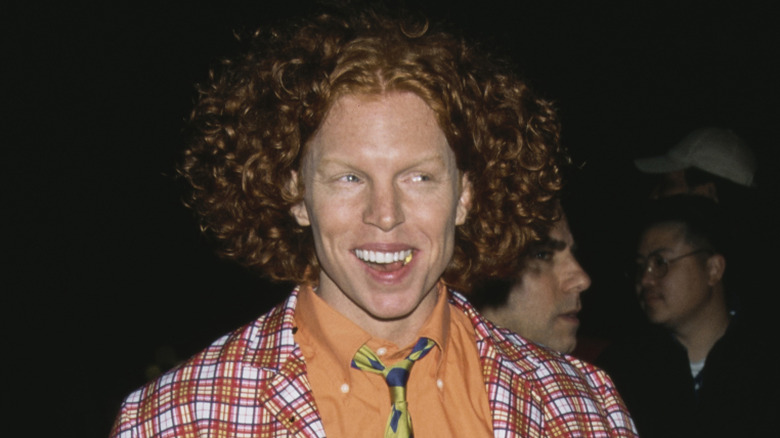
Scott Thompson was born on February 25, 1965, in Rockledge, Florida — a small city on Florida’s Space Coast that is significantly better known for rocket launches than comedy careers. He grew up in a middle-class family, attended Florida Atlantic University, and discovered stand-up comedy during his college years.
The prop comedy concept came naturally to him. Rather than building an act around pure observational humor or storytelling — the routes most aspiring comedians take — he leaned into physical gags, customized props, and a visual comedy style that owed as much to vaudeville and classic physical comedy as it did to the stand-up tradition.
The choice to specialize in prop comedy when the stand-up scene of the late 1980s was dominated by sharp-tongued observational comics was either very brave or very naive. Looking at the financial results, it was clearly the former.
His early stand-up career built momentum through relentless touring — the grinding, van-and-motel-room circuit that every comedian has to work before anyone gives them a stage worth standing on. He was funny, he was distinctive, and his shows were visually memorable in a way that pure stand-up rarely is. Word spread. Bookings improved. The trunk full of props got bigger.
The Career Timeline — How It Built

| Era | Years | What Was Happening |
|---|---|---|
| College beginnings | Early 1980s | Discovered comedy at Florida Atlantic University |
| Early touring | Late 1980s | Building the prop comedy act on the road |
| First TV appearances | Early 1990s | Stand-up specials, late night spots |
| MTV exposure | Early–mid 1990s | Mainstream recognition, younger audience |
| 1-800-CALL-ATT campaign | Mid–late 1990s | One of America’s most-aired TV commercials |
| Hollywood films | Late 1990s–2000s | Chairman of the Board and other film work |
| Las Vegas residency begins | 2005 | Luxor Hotel — the move that changed everything |
| Ongoing residency | 2005–present | 20+ years, still running, still selling tickets |
The shape of that career tells an interesting story. The early years built the foundation. The AT&T campaign built the national profile. And then the Las Vegas residency transformed everything — because it converted a touring comedian into a permanent, predictable, compounding income machine.
The 1-800-CALL-ATT Campaign — The Ad That Funded an Empire
Before the Vegas residency, before the $75 million net worth, there was a telephone. Specifically, there was a series of television commercials for AT&T’s 1-800-CALL-ATT service that aired with remarkable frequency throughout the late 1990s.
Carrot Top was the face of those commercials. The premise was simple — his prop comedy style translated naturally to a format where physical gags and visual humor could showcase the product in a memorable way. The ads ran constantly. You couldn’t watch television in the late 1990s without encountering Carrot Top holding a phone and mugging for the camera.
| 1-800-CALL-ATT Campaign | Details |
|---|---|
| Brand | AT&T |
| Era | Late 1990s |
| Format | TV commercials, high rotation |
| Impact | National household recognition |
| Financial value | Multi-million dollar deal |
| Career impact | Mainstream visibility beyond comedy clubs |
The financial details of the AT&T deal have never been fully disclosed, but major national advertising campaigns of that era — run at the frequency these ads ran — were worth significant sums to their talent. We’re talking multi-million dollar contracts for a campaign that ran for years.
More important than the direct payment was what the exposure did for his career. Before the AT&T ads, Carrot Top was a working comedian with a dedicated following. After them, he was a nationally recognized face that filled larger venues and commanded higher fees. That’s the kind of exposure money can’t buy — except apparently it could, and AT&T bought it on his behalf.
The irony of a phone ad funding a comedy empire is the kind of thing Carrot Top himself would probably build a prop around.
Las Vegas — The Golden Goose
If the AT&T campaign was the turning point in Carrot Top’s public profile, the Las Vegas residency is the engine of his wealth. And it has been running, without stopping, for over twenty years.
In 2005, Carrot Top began his residency at the Luxor Hotel and Casino in Las Vegas. He is still there. In 2025, that residency is in its third decade — making it one of the longest-running comedy residencies in Las Vegas history.
| Las Vegas Residency Facts | Details |
|---|---|
| Venue | Luxor Hotel & Casino |
| Started | 2005 |
| Duration | 20+ years and counting |
| Show frequency | Multiple nights per week |
| Ticket price range | $50–$80+ per ticket |
| Venue capacity | ~1,000 seats |
| Estimated annual earnings | $5–10 million from residency |
Do the math on those numbers. Even at a conservative estimate — 150 shows per year, 800 people per show, average ticket price of $60 — you’re looking at over $7 million in gross ticket revenue annually. After the Luxor takes its share and operational costs are covered, Carrot Top’s take is still a substantial annual income that he has been receiving consistently for twenty years.
Twenty years of consistent, significant annual income from a single source. Without a record label taking a cut. Without a film studio controlling the rights. Without the touring costs — hotel rooms, transport, logistics — that eat into a road comedian’s earnings. He lives in Las Vegas. He drives to work. He performs. He goes home.
That is not an accident. Moving to Las Vegas and anchoring himself to a residency was the single smartest financial decision of his career — and possibly one of the smartest financial decisions any comedian has ever made.
Think about what a touring comedian’s life looks like. Constant travel. Variable ticket sales. Venue fees. Promoter relationships. Weather cancellations. The residency model eliminates almost all of those variables. Carrot Top has been collecting steady, predictable, compounding income from the Luxor stage since George W. Bush’s first term in office.
Prop Comedy — The Business Behind the Laughs
People who dismiss prop comedy as simple or lazy have clearly never thought about what it actually involves to produce and sustain a prop comedy show at a professional level.
Carrot Top’s act requires a trunk — actually multiple trunks — of custom-built, carefully maintained props that are specific to his material. Every prop is a physical object that has to be designed, built, transported, stored, repaired, and eventually replaced. The logistics of running a prop comedy show are significantly more complex than running a conventional stand-up act, where everything you need fits in your head.
| What Prop Comedy Requires | Why It’s Actually Hard |
|---|---|
| Custom prop construction | Each gag requires a physical object built to spec |
| Maintenance and repair | Props break — they need to be fixed before every show |
| Storage and transport | Multiple large trunks require dedicated space and logistics |
| Material development | New props mean new ideas, design, and construction time |
| Physical performance | Managing props on stage while delivering timing and energy |
Beyond the logistics, there’s a competitive moat built into the format. You can steal a comedian’s jokes — they’re words, and words can be remembered and repeated. You cannot easily steal Carrot Top’s act because you can’t steal his props. The physical objects that make his comedy work are unique constructions that belong to him. He owns his material in a more literal sense than almost any other comedian working.
That moat is part of why he’s been able to sustain the same basic format for over three decades without a competitor meaningfully eating into his audience. There’s only one Carrot Top — and that’s as much a logistical reality as it is a branding statement.
Smart Money — How He Invested It
Having a large income and building lasting wealth are two different things. The entertainment industry is full of examples of people who earned enormous amounts of money and ended up with very little of it — poor financial management, bad investments, expensive lifestyles, and the tendency to spend as though the income will last forever.
Carrot Top has not followed that pattern.
| Asset Category | Details |
|---|---|
| Las Vegas real estate | Properties in the Las Vegas area |
| Primary residence | Upscale Las Vegas home |
| Performance income | Ongoing residency earnings |
| Business investments | Production and entertainment ventures |
| Historical endorsements | AT&T and other brand deals |
His real estate holdings in Las Vegas represent a smart alignment of lifestyle and investment. Las Vegas real estate has appreciated significantly over the past two decades — buying property in the city where you work and where you intend to stay long-term is basic financial sense, but it’s financial sense that many entertainers fail to exercise.
The overall picture is of someone who earned consistently, spent carefully, and invested in tangible assets rather than burning money on the kind of conspicuous consumption that makes for entertaining tabloid stories but terrible balance sheets.
The Physical Transformation — Staying Relevant
No article about Carrot Top in 2025 can completely ignore the elephant in the room — or more accurately, the significantly more muscular version of the man who used to be associated primarily with red hair and a trunk full of gags.
Over the past fifteen to twenty years, Carrot Top underwent a dramatic physical transformation. He became notably more muscular — a change that generated enormous media attention, significant public debate, and the kind of cultural conversation that keeps a person’s name circulating in ways that directly translate to ticket sales.
| Physical Transformation Timeline | Public Reaction |
|---|---|
| Pre-transformation | Known primarily for comedy, red hair, props |
| Early 2000s changes | Initial public notice of physical change |
| Mid-2000s onward | Media coverage, interviews, widespread discussion |
| Current physique | Well-maintained, continues to generate interest |
Whether the conversation was positive or negative almost doesn’t matter from a career visibility standpoint. People who hadn’t thought about Carrot Top in years were suddenly looking him up, searching his name, and — in many cases — buying tickets to see what he looked like in person.
Cultural relevance keeps seats filled. Keeps seats filled keeps the residency viable. Keeps the residency viable keeps the money coming in. The transformation, whatever motivated it personally, functioned as one of the more effective career reinvigoration moves in recent comedy history.
Carrot Top vs Comedy Peers — The Real Comparison
The temptation when writing about any comedian’s net worth is to compare them to Jerry Seinfeld or Kevin Hart — comparisons that tell you nothing useful because those are outlier careers at a completely different financial scale.
The more honest and interesting comparison is within Carrot Top’s actual competitive set — comedians of roughly his era, his mainstream profile level, and his style category:
| Comedian | Est. Net Worth | Known For | Career Status |
|---|---|---|---|
| Carrot Top | ~$75 Million | Prop comedy, Vegas residency | Active, thriving |
| Gallagher | ~$200K (at passing) | Prop comedy, Sledge-O-Matic | Passed 2022, financial struggles |
| Pauly Shore | ~$20 Million | MTV comedy, Encino Man | Working, significantly less wealthy |
| Sinbad | ~$4 Million | Stand-up, TV | Significant financial difficulties |
| Yakov Smirnoff | ~$10 Million | Russian immigrant comedy, Branson | Branson residency, much smaller scale |
That comparison is genuinely illuminating. Among comedians who rose to mainstream visibility in roughly the same era through similar novelty-adjacent fame, Carrot Top is not just ahead — he’s in an entirely different financial category.
Gallagher — the other famous prop comedian of their generation — died in 2022 with reported financial struggles. Pauly Shore, whose MTV fame was arguably more culturally significant at its peak than anything Carrot Top achieved, is worth a fraction of what Scott Thompson has accumulated. Sinbad, who had a television show and a film career that dwarfed Carrot Top’s Hollywood output, has faced public financial difficulties.
The comparison makes a point that the numbers alone might not fully convey: Carrot Top didn’t just get lucky. He made better decisions, built a more sustainable model, and converted his period of visibility into lasting wealth in a way that most of his peers simply didn’t.
What He Spends It On — Life in Las Vegas
For someone sitting on $75 million, Carrot Top lives with relative restraint by entertainment industry standards.
He owns a well-appointed home in Las Vegas — significant, comfortable, and appropriate to his income level without being the kind of estate that generates celebrity real estate news stories. He has maintained his physical fitness as an evident priority, which involves investment in training and health but is hardly the kind of expenditure that erodes a fortune.
He drives to work. Literally. The Luxor is in Las Vegas. He lives in Las Vegas. His commute is shorter than most people reading this article.
What he doesn’t spend money on — at least visibly — is the kind of lifestyle inflation that destroys celebrity fortunes. No record of fleet of exotic cars. No multiple mansion stories. No public financial crises. He earns well, he invests sensibly, and he lives comfortably without burning the foundation he’s spent thirty years building.
That combination — earning consistently, spending thoughtfully, investing in real assets — is the actual boring secret of how a prop comedian from Florida ended up with $75 million.
The Last Laugh
There’s a satisfying structure to the Carrot Top financial story that feels almost designed. The setup is the dismissal — a prop comedian with wild red hair who the serious comedy world never quite accepted, who critics never championed, and whose name became shorthand for a certain kind of lowbrow humor that sophisticated audiences were supposed to be above.
The punchline is $75 million, a twenty-year Las Vegas residency, and a net worth that exceeds virtually every comedian who ever looked down on the format he chose.
Carrot Top — real name Scott Thompson, 60 years old, still performing at the Luxor, still filling seats — never needed critical validation. He needed an audience, a stage, and the financial discipline to convert thirty years of performance income into lasting wealth.
He got all three.
The comedy world gave him the last laugh a long time ago. He just kept cashing it.
