
Connie Chung is one of the most significant and groundbreaking figures in the history of American broadcast journalism — a Chinese-American woman who carved space for herself in an industry that was overwhelmingly white, overwhelmingly male, and not particularly interested in changing either of those facts when she arrived. She did it anyway, with talent, tenacity, and a refusal to accept the limitations others tried to place on her ambition.
She is best known for her decades of work across the major American television networks — CBS, NBC, ABC, CNN, and MSNBC — where she reported on some of the most consequential stories of the late twentieth century, anchored major newscasts, and conducted interviews that became part of the cultural record. Her career spanned more than four decades of active broadcasting.
Beyond the professional achievements, Connie’s story is deeply human. It includes a long and genuinely loving marriage to talk show host Maury Povich, a painful and ultimately triumphant journey to motherhood through adoption, and the particular experience of being a pioneer — of being the person in the room who was not supposed to be there, and who stayed anyway.
She is also, it must be said, someone who has aged in public with a self-awareness and humor that has introduced her to an entirely new generation of admirers who may not have watched the CBS Evening News but who absolutely watched her viral musical moment decades into her career and loved every second of it.
| Detail | Information |
|---|---|
| Full Name | Constance Yu-Hwa Chung |
| Date of Birth | August 20, 1946 |
| Birthplace | Washington D.C., USA |
| Ethnicity | Chinese-American |
| Profession | Broadcast journalist, news anchor |
| Spouse | Maury Povich (married 1984) |
| Children | Matthew Jay Povich (adopted) |
| Education | University of Maryland |
| Notable Networks | CBS, NBC, ABC, CNN, MSNBC |
| Historic Role | Co-anchor, CBS Evening News with Dan Rather |
| Active Years | 1969 – 2006 (primary career) |
| Known For | Pioneering Asian-American broadcast journalism |
Early Life and Family Background
Connie Chung was born Constance Yu-Hwa Chung on August 20, 1946, in Washington D.C. — the youngest surviving daughter in a family that had emigrated from China and carried with them the particular combination of discipline, sacrifice, and ambition that tends to characterize families who have left everything familiar behind in pursuit of something better.
Her father, William Ling Chung, had been an intelligence official in China before the family’s immigration to the United States. He was, by all accounts, a man of considerable education and equally considerable expectations for his children. Growing up in a household shaped by those expectations left marks on Connie that are visible throughout her career — in her work ethic, her perfectionism, and her fundamental belief that excellence is not optional.
The family context was notable in another, more poignant way. Connie was the only one of ten siblings to survive childhood. Five siblings died before the family left China, and others did not survive the journey and its aftermath. She grew up aware of that weight — of being the one who made it, in a family where making it was never guaranteed.
Growing up Chinese-American in post-war Washington D.C. meant navigating a city that was in many ways still coming to terms with its own racial complexities. It meant being visibly different in environments that were not always welcoming of difference. And it meant developing, early, the capacity to perform competently in rooms where your presence was not fully anticipated or entirely welcomed — a skill that would serve her throughout her professional life.
Education and the Path Into Journalism
Connie attended the University of Maryland, where she studied journalism — a choice that reflected both genuine passion and considerable pragmatic calculation. Television news in the late 1960s was beginning to expand, driven by the growing cultural centrality of the medium and the enormous appetite for coverage of a world that seemed to be changing at an almost incomprehensible pace.
She was drawn to broadcast journalism specifically because of the combination it offered — the immediacy of television, the responsibility of journalism, and the opportunity to communicate directly with a mass audience in real time. For a woman of her intelligence and ambition, it was a field that promised genuine significance alongside genuine challenge.
Her early professional experiences were in local Washington D.C. television, where she began developing the craft that would eventually take her to national prominence. Local news is an unforgiving training ground — the pace is relentless, the resources are limited, and the learning curve is steep. Connie navigated it with a seriousness of purpose that distinguished her from the beginning.
What she encountered in those early years — the casual assumptions about what women could cover, the limited roles considered appropriate for Asian-American faces on television, the need to be demonstrably better than comparable male colleagues to receive comparable consideration — did not discourage her. It clarified her.
Breaking Barriers: The Historic Rise
Connie’s move to CBS News as a correspondent in the early 1970s represented her entry into the national stage — and it came at a moment when the presence of a Chinese-American woman in that role was genuinely unusual enough to constitute a statement in itself.
She covered major national stories with the seriousness and capability that serious journalism demands. Political reporting, investigative work, features that required both intellectual depth and genuine human sensitivity — she demonstrated across all of these that her presence was justified by performance, not tokenism.
What it meant to be an Asian-American woman on national television in the 1970s is difficult to fully communicate to those who did not witness it. The default image of broadcast authority in that era was specific and narrow — white, male, measured. Connie’s face on screen was, for many Asian-American viewers, something they had simply never seen before in that context. The significance of that visibility — of seeing someone who looked like you occupying a position of professional authority — cannot be overstated.
She has spoken in interviews about the specific barriers she encountered — the assumptions, the limited opportunities, the moments when her competence was questioned in ways that had nothing to do with her actual work. She navigated these not by pretending they did not exist but by continuing to perform at a level that made them increasingly difficult to sustain.
Career Highlights and Major Roles
Connie Chung’s career across multiple major American networks over four decades produced a body of work that is remarkable both in its breadth and its consistent quality.
| Year | Role / Achievement |
|---|---|
| 1969 | Begins career at WTTG, Washington D.C. |
| Early 1970s | Joins CBS News as correspondent |
| 1983 | Joins NBC News as anchor |
| 1989 | Returns to CBS News |
| 1993 | Named co-anchor of CBS Evening News with Dan Rather |
| 1995 | Departs CBS following controversies |
| 1997 | Joins MSNBC |
| 2002 | Joins CNN |
| 2003 | Launches Connie Chung Tonight on CNN |
| 2006 | Final major network role ends |
Her most historically significant professional moment came in 1993 when she was named co-anchor of the CBS Evening News alongside Dan Rather. She became only the second woman in American history to anchor a major network evening newscast — a milestone that carried genuine weight in an industry where that particular chair had been the exclusive province of men since television news began.
The role represented the formal recognition of everything she had built over two decades of serious journalism. It was also, as it turned out, one of the most scrutinized and ultimately complicated chapters of her career.
Her interviews over the years produced moments that became part of the broader cultural conversation. She had a genuine gift for the long-form interview — the ability to build enough trust with a subject that they revealed more than they might have intended, while maintaining the journalistic discipline to use that material responsibly.
The Controversies That Came With the Territory
No honest account of Connie Chung’s career can avoid the controversies that punctuated it — and no fair account should want to, because those controversies reveal as much about the industry she worked in as they do about her.
The most discussed incident involves her 1995 interview with Kathleen Gingrich, mother of then-House Speaker Newt Gingrich. During the interview, Connie asked Kathleen what her son had said about Hillary Clinton. When Kathleen hesitated, Connie leaned in and said — in what she presented as a confidential aside — “just whisper it to me.” Kathleen did, saying that Newt had called Clinton a “bitch.” The comment aired.
The fallout was significant. Critics accused Connie of journalistic manipulation — of using the pretense of confidentiality to extract a comment she knew would be aired. The incident generated genuine debate about interview ethics and contributed to the professional difficulties she experienced at CBS that year.
It is worth sitting with the full complexity of that moment. The criticism was not entirely without merit — the “whisper” framing was at minimum a questionable journalistic technique. But it is also worth noting that male journalists who employed aggressive or unconventional tactics to extract newsworthy information were rarely subjected to the same level of sustained professional consequence that Connie faced.
Her departure from CBS in 1995 was accompanied by a public narrative that placed significant blame on her. The reality, as with most complex professional situations, was considerably more nuanced. What is clear is that she handled the professional setback with the same resilience she had always brought to difficulty — by continuing to work, to report, and to demonstrate her capability across subsequent roles at MSNBC and CNN.
The broader pattern of her career controversies reflects something real about the impossible standards applied to women in positions of broadcast authority. Errors that were forgiven or forgotten in male colleagues became defining narratives for Connie in ways that speak to dynamics well beyond any individual incident.
Maury Povich: The Love Story Behind the Career
One of the most genuinely heartwarming dimensions of Connie Chung’s public story is her marriage to Maury Povich — a relationship that has now spanned four decades and that both parties describe with a warmth and humor that feels entirely authentic.
They met in the professional world of Washington D.C. broadcasting — two ambitious, talented, driven people who found in each other something that their careers alone could not provide. The attraction was apparently immediate and the relationship developed with a seriousness that led to marriage in 1984.
What makes their partnership particularly interesting is the professional symmetry it contains. Both Connie and Maury were, at various points in their careers, among the most recognizable figures in American television. They understood from the inside what the other’s professional life demanded — the travel, the pressure, the public scrutiny, the emotional investment that serious journalism and serious television both require.
Maury has spoken in interviews about his deep admiration for Connie’s talent and his genuine pride in her professional achievements. Connie has spoken about Maury’s warmth, his humor, and the stability he brought to a life that could have been unmoored by its own professional intensity.
They are, by every available account, genuinely good for each other. That is rarer than it sounds, particularly in an industry that has historically not been kind to the personal lives of the people who work within it.
Their relationship has also been characterized by a capacity for mutual support through difficulty — most significantly through the fertility struggles and eventual adoption that represent perhaps the most personally challenging chapter they have navigated together.
The Deeply Personal Journey to Motherhood
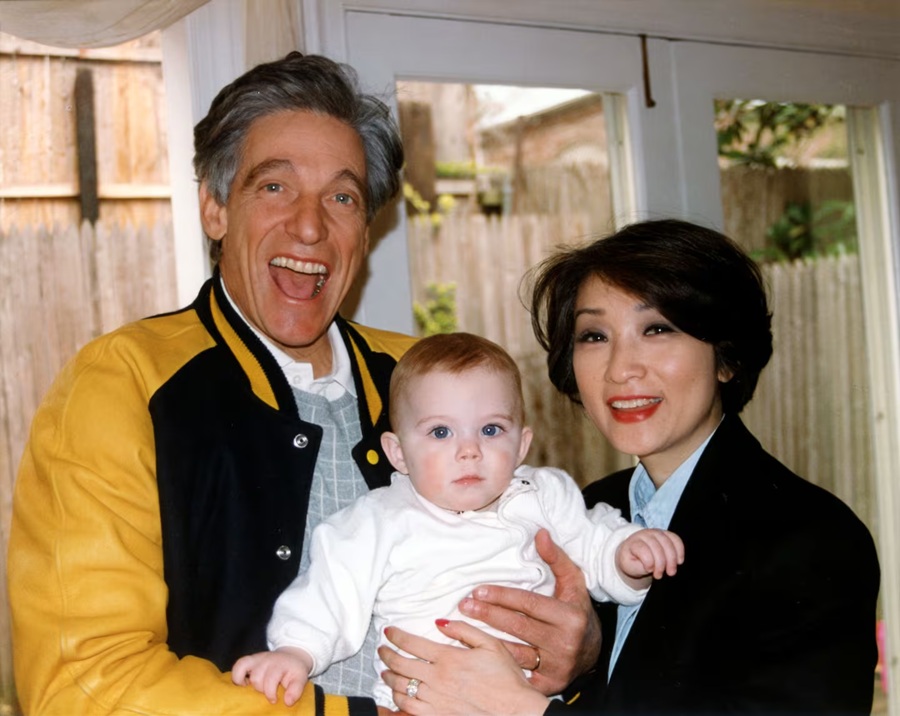
Connie and Maury’s journey to parenthood is one of the most humanizing and moving dimensions of their public story — and one that both have spoken about with a candor that reflects genuine desire to be honest about an experience that many couples navigate in silence.
They tried for years to have biological children. The fertility treatments, the hope, the repeated disappointment — this is a journey that millions of couples know intimately, and Connie’s willingness to speak about it publicly has provided a kind of companionship to others living through similar experiences that is genuinely valuable.
The decision to adopt came after years of medical interventions that did not produce the outcome they hoped for. It was not a consolation prize or a fallback option — it was a genuine and considered choice made by two people who wanted to be parents and who found a path to that goal that was right for them.
Matthew Jay Povich arrived in their lives and transformed them in the ways that children transform the lives of people who have waited and hoped for them. Both Connie and Maury have spoken about Matthew with a love and pride that is palpable even in the controlled environment of a television interview.
The adoption involved a child of Korean heritage — a fact that adds a layer of complexity and richness to the family’s story, and one that Connie has acknowledged thoughtfully in discussing how she and Maury have approached questions of identity and heritage with Matthew. Transracial adoption carries responsibilities that go beyond love — the responsibility to honor a child’s heritage, to provide them with connection to their birth culture, and to prepare them for the particular experience of moving through the world in a body that does not match their parents’. Connie’s public comments on this suggest genuine thoughtfulness about these dimensions of their family’s life.
Asian-American Identity and Cultural Legacy
Perhaps the most enduring and significant dimension of Connie Chung’s legacy is what her career meant — and continues to mean — for Asian-American women in journalism and broadcasting.
When she appeared on national television in the 1970s and built toward the anchor chair at CBS in the 1990s, she was doing something that had genuinely not been done before at that level. She was demonstrating, through sheer accomplished presence, that the default image of broadcast authority did not have to be what it had always been.
For Asian-American girls and young women watching television in those decades, seeing Connie Chung in that role was not a small thing. Representation of that kind — visible, serious, accomplished — communicates something to young people about what is possible for them that no amount of verbal encouragement can fully replicate.
She has spoken thoughtfully in interviews about the particular experience of navigating her identity within her profession — the moments when she was exoticized rather than respected, the assumptions that came with being visibly Chinese-American in a field that had not historically made space for that identity, and the complex relationship between visibility as representation and visibility as exposure to a particular kind of scrutiny.
Her legacy in this dimension of her story is not simply that she was the first or among the first in various roles. It is that she was genuinely excellent in those roles — that she gave subsequent generations of Asian-American journalists not just a symbol but a standard.
Later Career and Reinvention
Connie’s primary broadcasting career wound down in the mid-2000s, but her cultural presence has never entirely disappeared — and in recent years it has experienced a genuine and delightful revival.
Her 2023 appearance in which she performed a musical number — a moment of pure, self-aware joy that spread across social media with remarkable speed — introduced her to an entirely new generation of admirers who encountered her first as someone willing to be genuinely funny and entirely unguarded rather than as the serious broadcaster their parents remembered.
The response was enormous and warm. People were charmed not just by the performance itself but by what it communicated about who she is — a woman in her seventies who has earned the right to be exactly herself, who has nothing to prove and no persona to protect, and who finds genuine pleasure in connecting with people in whatever form that connection takes.
This later public chapter is, in its own way, as revealing of her character as anything in her professional career. The willingness to be vulnerable, to be funny, to invite people into a version of yourself that is less polished and more purely human — that requires a confidence that can only come from having genuinely made peace with your own story.
Awards, Recognition, and Professional Legacy
Throughout her career, Connie received recognition that reflected the breadth and quality of her work — multiple Emmy Awards for her journalism, recognition from professional journalism organizations, and the kind of sustained industry respect that is built over decades rather than awarded quickly.
Her place in the history of American broadcast journalism is secure and significant. She is studied in journalism schools as both a practitioner and a historical figure — someone whose career illuminates important truths about the evolution of television news, the treatment of women in broadcasting, and the complex intersection of representation and excellence.
The Asian-American Journalists Association and similar organizations have honored her contributions repeatedly over the years — recognition that reflects not just her professional achievements but the specific significance of what she represented for a community that was largely invisible in American broadcasting when her career began.
Why Connie Chung Still Matters Today
The conversation about representation in American media — about who gets to be on screen, who gets to be in the anchor chair, whose face is considered the natural face of authority — is very much still happening. In that conversation, Connie Chung’s career is not history. It is evidence.
She demonstrated, across four decades of serious professional work, that the limitations placed on Asian-American women in broadcasting were not reflections of any actual limitation. They were reflections of a failure of imagination on the part of an industry that had defined its own norms too narrowly.
Her story also teaches something about persistence that goes beyond professional inspiration. She encountered genuine obstacles — prejudice, professional setbacks, personal difficulties — and she continued. Not because she was impervious to the difficulty but because the alternative was unacceptable to her.
And there is the human story beneath the professional one — the marriage that has lasted, the child who was chosen and loved, the woman who has moved through an extraordinary public life and emerged from it with her sense of humor and her fundamental warmth intact. That story is, in the end, the most compelling one.
Conclusion
Connie Chung is more than a broadcast journalism milestone. She is a complete human being whose life — professional, personal, and everything in between — represents something genuinely worth understanding and celebrating. She broke barriers not by being perfect but by being excellent, by being persistent, and by refusing to accept a smaller version of her own ambition than the one she had arrived with. In a field that was not built for her, she built something remarkable. And four decades later, the evidence of what she built is visible everywhere — in every Asian-American woman who sits behind a network news desk, in every young journalist who saw her face and understood for the first time that the room had space for them too.
